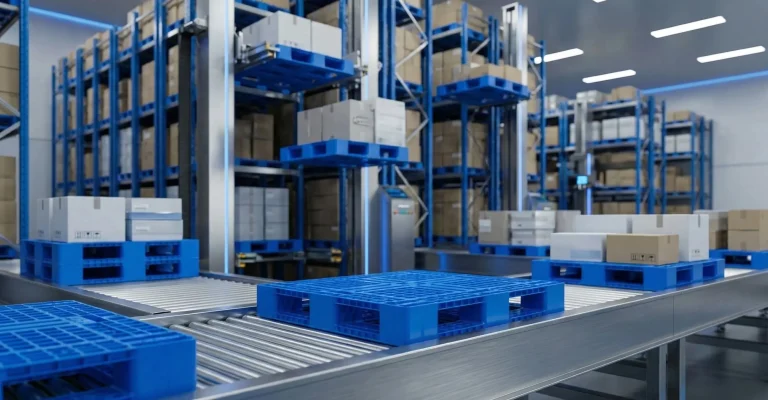
Automation is reshaping the modern warehouse: From high-speed conveyor lines to fully integrated Automatic Storage and Retrieval Systems (ASRS), companies are moving toward operations that are faster, safer, and more cost-efficient.
But while the focus usually falls on robotic arms or sophisticated racking structures, one essential component often gets overlooked: the pallet itself.
A poorly designed pallet can slow down an entire automated system, trigger unnecessary stoppages, or wear down machinery. This is where plastic pallets have become a preferred choice for automation-driven environments, replacing traditional wood pallets that can be inconsistent, abrasive, and structurally unpredictable.
Below, we break down why plastic pallets are becoming an integral part of warehouse automation, what advantages they offer, and what decision-makers should look for when choosing the right pallet for ASRS, conveyors, and high-precision handling systems.
First, let’s examine why wood pallets struggle in automated warehouses
For decades, wood pallets were the default in warehousing. But automation demands precision, and that’s where wood tends to fall short due to inconsistent dimensions that disrupt automated grabbing, positioning, or conveyor flow.
The following are issues commonly linked to wooden pallets:
- A lack of uniformity in pallet dimensions can significantly contribute to increased downtime and reduced throughput in automated systems.
- Splintering, and moisture absorption further increase contamination risks and equipment wear, causing frequent stoppages and maintenance issues.
- Loose nails or broken boards are common causes of jams, damaging conveyor rollers and robotic grippers.
Automation systems are built around tight tolerances. If the pallet shape varies, the entire operation feels it.
Why do flat plastic pallets do so well in automated environments?
Flat plastic pallets address every limitation above. Their design, materials, and manufacturing process create a level of consistency that automated systems depend on.
Key advantages include:
1. Dimensional accuracy
Plastic pallets are injection-moulded, giving them consistent dimensions, weight, and deck flatness. This stability helps with:
- Smooth conveyor travel
- Reliable ASRS shuttling
- Accurate robotic or AGV handling
- Better control within system tolerance dimensions
In short, machines can “trust” plastic pallets to behave the same way every time.
2. Perfectly-flat bottom surfaces
Flat pallets reduce vibration and tilting on conveyors. They also prevent product overhang, improving load stability and lowering the risk of packages shifting or slipping during automated movement.
3. Higher structural integrity
Advanced engineering and steel reinforcements (when used) allow plastic pallets to handle high racking loads with minimal deflection. This is especially critical for ASRS, where deep racks and narrow aisles amplify stress on pallet structures.
4. Lower wear on machinery²
Plastic pallets don’t shed debris, don’t splinter, and don’t expose nails or broken boards. As a result:
- Conveyor rollers last longer
- Automated grippers work more reliably
- Sensors and scanners operate without obstruction
Fewer interruptions mean higher overall efficiency.
5. Hygiene and cleanability
Flat plastic pallets are non-porous and easy to wash, making them a natural fit for industries such as food, beverage, and pharmaceuticals, all of which are increasingly automating.
What should you look for when choosing pallets for automation?
Choosing the right pallet isn’t just about material; it’s about engineering, compatibility, and performance. Key considerations include:
1. Pallet size and dimensional tolerance
Common sizes like 1200×1000 mm or 1200× 1200 mm work best with global conveyor and ASRS standards. Precision tolerances help ensure smooth, jam-free movement.
2. Deflection control
For ASRS, minimal deflection is non-negotiable. Look for:
- Steel reinforcement
- Optimised rib structure
- Proven rack-load test data
A pallet that deflects too much can cause rack-stop errors or sensor misreads.
3. Surface design
A flat, closed-deck design supports automation, preventing product catch-points and improving stability during high-speed movement.
4. Compatibility with existing systems
Different conveyor types (roller, belt, chain, etc) behave differently. The pallet should be tested (or certified) for compatibility.
5. RFID & barcode compatibility
Automation relies on accurate tracking. Pallets with dedicated zones for RFID tags or barcode labels ensure consistent scanning and reliable data capture across ASRS and conveyor systems.
IntracoPallet’s products are designed with automation in mind
To help you decide on which pallet to go with, here’s how IntracoPallet’s engineered pallet families fit into automated or semi-automated operations.
These are the go-to choice for fully automated warehouses that require maximum precision.
- Ultra-high-strength structural design
- Meets system deflection requirements
- Steel-reinforced options available
- Built specifically for ASRS
- Excellent dynamic and racking performance
P-Series (Pharmaceutical Pallets)
Designed for facilities where hygiene and precision intersect.
- Fully flat and smooth, including under-deck
- Ultra-hygienic design
- Steel-reinforced for stacking and racking
- Made for sensitive, contamination-free environments
S-Series (Super Hygiene Pallets)
Best for food, beverages, pharmaceuticals, and cleanroom automation.
- Exceptionally smooth flat surface
- Suitable for HACCP/GMP environments
- Steel-reinforced for strong racking loads
- Available in single, double, reversible, or 9-leg options
H-Series (Heavy-Duty Warehouse & Shipping Pallets)
Great for high-load conveyors, automated handling, and deep-rack storage.
- Heavy-duty construction with high dynamic loads
- Reversible and double-deck options
- Suitable for both internal storage and outbound transport
- Strong rib structure and steel-reinforced models available
M-Series (Medium-Duty Warehouse Pallets)
Practical solutions for semi-automated or hybrid operations.
- Lightweight but strong enough for stacking
- Suitable for light racking
- Available in various sizes and entry types
- Ideal for conveyors, sorting, and internal warehouse flow
You can also see the full IntracoPallet lineup at a glance here.
It’s time to let IntracoPallet power your move into automation
As warehouses evolve toward faster, smarter, and more automated operations, the role of the pallet becomes increasingly critical.
Plastic pallets aren’t just load carriers anymore — they’re engineered components that keep ASRS, conveyors, and automated handling systems running smoothly and reliably.
IntracoPallet has supported Malaysian businesses since 1994, helping companies modernise their warehouses with the right pallet solutions for automation, hygiene-sensitive environments, and high-performance logistics.
Our engineering team can assess your operational needs, recommend suitable pallet models, and ensure compatibility with your existing or upcoming automation systems.
If you’re upgrading to ASRS, enhancing conveyor efficiency, or simply looking for a pallet that delivers consistency day after day, we’re here to help.Reach out to us today and let our experts match you with flat plastic pallet solutions that boost reliability, precision, and long-term operational efficiency.